Should Covid-19 vaccines have intellectual property rights?
“Could you patent the sun?” This is a famous saying by Dr. Jonas Edward Salk more than 60 years ago. Dr. Salk is an American virologist – an expert who studies viruses and the diseases that they cause. In the wake of the Covid-19 pandemic raging on across the world, Dr. Salk’s action regarding the patent for the polio vaccine has become more and more relevant today.
Jonas Edward Salk (October 28, 1914 – June 23, 1995) was an American virologist and medical researcher who developed one of the first successful polio vaccines. Although Dr. Salk is a great doctor with achievements that have changed the world, he is also very humble, stating and expressing in action many times that to profit from medicines is an unimaginable behavior.
He asserts that vaccines belong to the people and should be distributed to the entire population free of charge, not for profit.
His action has resulted in many changes to the world. One of the most seeable changes is to the life of another great Professor – Mrs. Joan McMeeken, a well-known physiotherapist from Melbourne, Australia.
As one of the first Australian teenagers to receive the polio vaccine in the 1950s, Mrs. McMeeken claimed that when the vaccine for polio, developed by Dr. Jonas Salk in the United States, was first available in Australia, the news has been enthusiastically received by the people.
She shared about her past battling polio more than 50 years ago: “They are really eager to get their kids vaccinated, especially if they know someone who has had polio. Having worried about polio for 50 years, everyone is relieved that the vaccine is now available”.
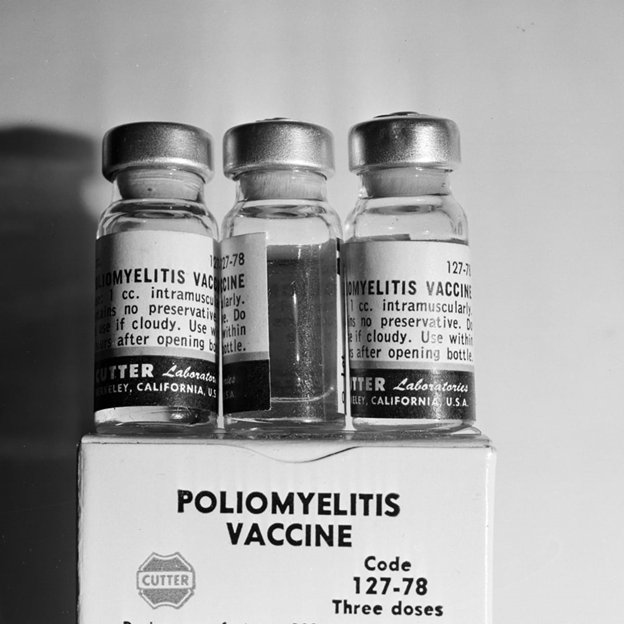
Dr. Jonas Salk did not patent his polio vaccine.
As the vaccines gather more and more success, saving the lives of countless citizens across the world, the inventor of the polio vaccine was confronted with concerns about intellectual property rights and patents.
When asked, Dr. Salk’s response was made public in newspapers around the world, changing the perspective that drugs and money must always be in parallel.
“Who owns the vaccine patent? Everybody. There is no such thing as a patent. Could you patent the sun?”
More than 60 years have gone by since the time Dr. Salk shared that opinion, yet as the world struggles with the Covid-19 pandemic, coming to the end of this dreadful moment, major questions regarding the importance of intellectual property rights in vaccine development remain unanswered.
Uses of vaccine patents
In order to stop rivals from stealing a pharmaceutical company’s ideas and mass-producing similar goods, vaccine patents were developed. In the US and Australia, patents in the field of pharmaceuticals are generally valid for 20 years from the date of successful issuance.
Vaccine manufacturers and researchers patent vaccines because the vaccine will generate a high profit for them. In contrast to the majority’s thinking, this is understandable because, to effectively research a vaccine for a serious disease in the world, it took them years of development.
As a result, it is not bizarre for them to want to profit from their sweat, hardship, and investment. According to a study by The Washington Post, on average, to be able to research a vaccine for a new disease, the development company will need an amount of money in the range of 521 million USD to 2.1 billion USD (Figures can vary greatly for different diseases, companies, and countries researching and developing vaccines).
Taking years to develop and put the drug into use, companies typically enjoy more than 10 years of uncompetitive sales. Not stopping there, they will try to improve and expand the use even after the product has been released. Therefore, the manufacturer applies for additional patents and maintains a monopoly in the market for many more years.
Does the Covid-19 vaccine patent need to exist?
Dr. Nikolai Petrovsky of the Flinders College of Medicine and Public Health, who is conducting research at the vaccine development company Vaxine in Adelaide, stated that patents for Covid-19 vaccines are crucial for the growth of the economy.
Since the September 11 attacks, his company has attracted funding from the US government to research and develop a vaccine in the wake of the anthrax epidemic. Since then, their patented vaccine research method has been used in vaccine development projects in response to outbreaks of other diseases including swine flu, Ebola, and MERS.
Dr. Nikolai Petrovsky said that being able to protect intellectual property has helped the company a lot economically in the research and development of vaccines. “The reason we have a patent is to reward the effort of every member involved in the research and production of new technology. We have been developing our vaccine for 20 years now and have invested over $50 million in the process,” he said.
“It would be unfair if we invested 20 years of effort and all that money and then released a new vaccine that has benefits that other pharmaceutical companies don’t have. Then someone could come up with an imitation drug a week later and potentially push us out of the market.”
In Australia, standard patents on a device, substance, method or process last for 20 years and allow the patent holder to use it commercially for that time.
Dr. Petrovsky said being able to patent new versions of vaccines serves as a driving force for innovation in the economy.
Simply put, if we can’t reap the profits after that much hard work and money invested directly for years, what would be the motivation? Vague things like the benefits of the people, the country are good in fairy tales, but in reality, that is basically not realistic.
Even if the researchers somehow do it for the people, would they be shocked and enraged to see that some other companies gather profits by copying and selling the vaccines, gaining billions of USD while their company – the one who manufactures and develops the vaccine got nothing?
Should intellectual property rights related to Covid-19 vaccines be exempted?
Although the idea of protecting the rights and motivating companies to develop more in the future is sound, La Trobe University associate professor of public health Deborah Gleeson – who represents Australia’s Public Health Association – asserted that the COVID-19 global health crisis has brought attention to the negative aspects of intellectual property rights.
Some years ago, the organization Doctors Without Borders Médecins Sans Frontières said it was estimated that six projects leading research into COVID-19 vaccines received $12 billion in public funding during the pandemic. So, should vaccine companies limit competition by holding on to vaccine patents when public funds make up a large part of the vaccine’s research and development process?
As such, according to Gleeson, the idea that patents allow vaccine companies to remain economically viable is not necessarily correct. “That logic doesn’t hold true in the context of a pandemic,” she said.
In order to counter the pandemic, the government and the public have contributed a significant sum of money to the study and production of COVID-19 vaccines and other medical items. So, is it fair that the ownership of the vaccine does not belong to everyone?
Movements of countries on the issue of Covid-19 vaccine patents
The Australian Public Health Association and Doctors Without Borders Australia had written a letter calling on the federal government to support a proposal to not patent Covid-19 vaccines.
The exemption of intellectual property rights related to vaccines has precedent. Two decades ago, the WTO approved temporary patent exemptions to allow poor countries to import cheap generic drugs to treat HIV, tuberculosis, and malaria amid a health crisis.
Since October 2020, India and South Africa have also led the movement of giving up intellectual property rights around products that helped to put a stop to the Covid-19 pandemic through the International Trade Organization (WTO). The declaration received the support of more than 100 member countries at that moment.
The United States – the most powerful country in the world, and leader of the free world, has also supported the exemption of intellectual property rights related to Covid-19 vaccines.
On June 17, 2022, nearly 2 years after the proposal, 164 members of the World Trade Organization (WTO) agreed to approve a temporary agreement to exempt intellectual property rights for Covid-19 vaccines so that countries can produce Covid-19 vaccines without worrying about IP infringement.
However, this deal is not of infinite terms. The exemption only lasts for 5 years and in the context that the Covid-19 pandemic has already nearly come to an end, the agreement is more of a formality, a ‘show’ for the world.
Nonetheless, it is still the right move that needs to be taken. Regarding the question of whether should Covid-19 vaccines be protected with IP rights, the writer of this article sees that IP rights protection is absolutely necessary for a modern economic world.
Patents, as well as copyright, trademark, industrial designs, etc., are all important IP rights to protect the rights of IP owners after they have invested so much into that asset. The protection will create motivation for researchers, developers, playwriters, singers, authors, creators, etc. all around the world.
It’s not just about the reward, it’s the issue that without IP, the world will be in constant conflicts of copying and stealing, creating no motivation and the need to develop, killing the progress of mankind as we have known for thousands of years.
That being said, in drastic times when IP has become a barrier to the protection of human life, world governments, and international organizations should join hands and agree on some kind of temporary exemption deal as fast as they can, as no economic benefits are worthy of the lives of a single human.
AAA IPRIGHT – Global IP – Global Trademark Registration
Contact AAA IPRIGHT: Email: [email protected]
Or sending your inquiry by filling the form: