Are game show formats covered by copyright in Vietnam?
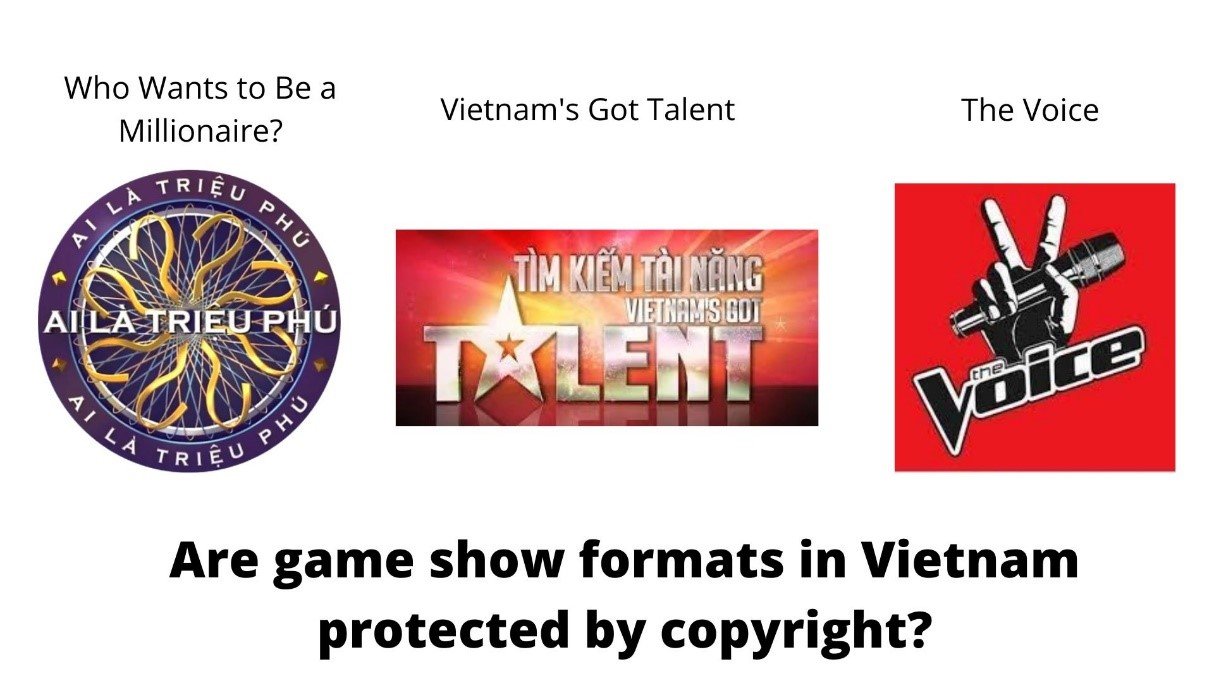
In the Vietnamese entertainment sector, as well as the global market, TV game shows are quite popular. Many well-known game shows from other countries, such as ‘Who Wants to Be a Millionaire?’, ‘Vietnam’s Got Talent,’ and ‘The Voice,’ have been franchised or licensed for transmission in Vietnam, attracting big audiences and earning billions of VND through commercialized activities.
Other successful programs have been produced in the United States, some of which are entirely unique, but many of them bear a strong similarity to existing shows in other regions, with comparable gameplay, settings, and even titles.
From the standpoint of intellectual property, this raises the intriguing question of whether game show owners or producers may sue these copycat shows for infringement. In other words, can a game show be protected under intellectual property law if format rights are recognized as a copyright?
Many well-known game shows from other countries, such as ‘Who Wants to Be a Millionaire?’, ‘Vietnam’s Got Talent,’ and ‘The Voice,’ have been franchised or licensed for transmission in Vietnam, attracting big audiences and earning billions of VND through commercialized activities.
On a global scale, there is a lack of a clear and unequivocal response to this issue. The Format Recognition and Protection Association (FRAPA), a trade group founded in 2000 to advocate for the recognition of television formats as intellectual property, believes strongly in the protection of format rights and has been working to persuade courts and legislators worldwide to do so. However, format rights are still seldom recognized and are generally decided on a case-by-case basis.
Legal experts frequently argue that because a game show’s framework is merely made up of concepts that aren’t protected by law, it can’t be subject to copyright (for example, Green v. Broadcasting Corporation of New Zealand in 1989). Others say that if a game show’s framework is an intellectual production with important aspects of distinctive originality, rather than a collection of generic and ubiquitous parts, it can be protected under copyright laws (for reference, Meakin v BBC [2010] EWHC 2065).
Format rights in Vietnam
Formats are not protected by Vietnamese IP law, and there are no procedures for infringement or enforcement of format rights. In other words, format rights in Vietnam have yet to be recognized. However, it is thought that a game show can be protected separately under IP Law via copyright for literary works for the scripts; and (ii) theatrical works for the game show’s “expression” on stage (including the concept, structure, studio and lighting design, rules, etc.).
The IP Law does not require copyright owners/authors to register their works (in this context, literary works or dramatic works), but it is a recommended and easy way to prove the ownership of a copyrighted work in order to prevent potential infringement.
Assessment of copyright infringement between game shows
Although there is a means to partially protect a game show’s copyright, it is significantly more problematic when it comes to a claim of copyright infringement, especially since the worldwide entertainment business has developed and broadcast hundreds of game shows with numerous characteristics and aspects in common.
At least three characteristics are to be evaluated for determining copyright infringement, especially for literary and theatrical works: originality, resemblance of the disputed works, and the willfulness of the claimed infringer. It might be tough to demonstrate originality. Many game shows fit into well-known genres with similar concepts and structures, such as quiz shows or talent shows. Most singing contests, such as the “Idol” and “The Voice” franchises, have candidates perform on stage, after which the panelists/judges provide feedback and scores, and singers are removed round by round until a championship or grand finale determines the show’s winner. It’s difficult to claim that these features provide a game show’s formula uniqueness when they’re so widespread. Even while each game show is an interactive event in which players are free to act and speak outside of any prewritten script, it is unlikely that such acting and reacting will make the entire game show unique.
When determining if an allegedly infringing program is a copy or a derivative work of the previous show, it’s also crucial to look for similarities between the two shows. For this reason, it’s crucial to figure out whether the comparable parts are necessary for the overall presentation or merely happenstance. Both ‘Who Wants to Be a Millionaire?’ and ‘Rồng Vàng’ (a popular game show in Vietnam from 2003 to 2007, licensed from a Thai show) have similar elements and structures, in which a single contestant tackles a series of multiple-choice, general-knowledge questions in order to win a large cash prize, and can consult with family and friends to find the answer.
A watcher of both programs would undoubtedly notice a similarity and may mistake one for the other. However, no infringement complaint has ever been filed to our knowledge, most likely due to the originality problem. The features that were the most similar were common or perhaps intrinsic to the quiz show genre, and the components that were probably the most distinct – such as the quantity of the cash reward, which was a significant element of the ‘Millionaire’ brand – were distinct.
Finally, the claimant must show that the infringement copied the original work in question with intent. This can be proven indirectly by demonstrating that the original work was made, published, or registered before the copycat, and that the infringer should have understood that its work potentially infringe on the claimant’s rights.
Conclusion
While Vietnam’s IP Law does not expressively provide copyright protection for game shows, it is clear that a game show can indirectly be protected through its literary works and/or dramatic works. However, it is not easy to enforce the copyright of a game show in practice because in the entertainment industry, there is a blurred line between copyright infringement and the similarity of ideas among game shows. Thus, one must carefully evaluate and assess the show’s originality and the similarity between the disputed game shows, and the willfulness of the infringer. Only when all the criteria are satisfied can we say that there is a copyright infringement of the game show.
*** Other Articles***
– You could visit here to see the Trademark Registration in Vietnam.
– You can also check the Vietnam Trademark Law: Detailed Guide And Legal Notes.
– You could check Questions of filing trademark in Vietnam: POA, Trademark requirement and trademark fee in Vietnam.
Contact AAA IPRIGHT: Email: [email protected]
Or sending your inquiry by filling the form: