

Trademark in South Korea, South Korea Trademark
TRADEMARK IN SOUTH KOREA
Trademark in South Korea includes three stages: trademark search in South Korea, South Korea Trademark filing and South Korea Trademark registration. All with affordable fees.
– Stage 1: TRADEMARK SEARCH IN SOUTH KOREA
| Scope of work: Trademark Search | Word mark
($US) |
Device (logo) And/Or Word Mark
($US) |
| For the 1st class | 100.00 | 185.00 |
| For the 2nd class | 80.00 | 150.00 |
| Duration | 5-8 days |
– Stage 2: TRADE FILING IN SOUTH KOREA
| Scope of work: Filing Trademark Application | FEE
($US) |
| For the 1st class | 400.00 |
| For the 2nd class | 350.00 |
| Duration | 16-18 months |
– Stage 3: TRADEMARK REGISTRATION CERTIFICATE IN SOUTH KOREA
| Scope of work: Obtaining trademark registration certificate | FEE
($US) |
| For the 1st class | 280.00 |
| For the 2nd class | 250.00 |
| Duration | 1 month |
* Note: Our Fee for Trademark in Korea includes all fees (official fee and legal fee); exclude fee for responding to office action, if any.
*For trademark in South Korea, The additional fee of US$4.00 will be charged for each of designated goods exceeding 20 goods for each class.
– You could visit here to see Procedure of South Korea Trademark Registration.
– You could visit here to check the required documents for filing trademark in South Korea
Contact AAA IPRIGHT: Email: [email protected]
Or sending your inquiry by filling the form:
The Philippines to cooperate with South Korea to promote IP-based professions
To satisfy the growing need for intellectual property (IP) professionals servicing the Philippines’ innovation, creativity, and commercial markets, the Intellectual Property Office of the Philippines (IPOPHL) is now examining the deal with the Korean Invention Promotion Association (KIPA). Korea Invention Promotion Association Korea Invention Promotion Association (KIPA) was established in 1994 to promote intellectual property (IP) and expand patent management support. KIPA provides a ONE-STOP service that offers assistance from the early stages of inventions to commercialization. Moreover, KIPA trains human [...]
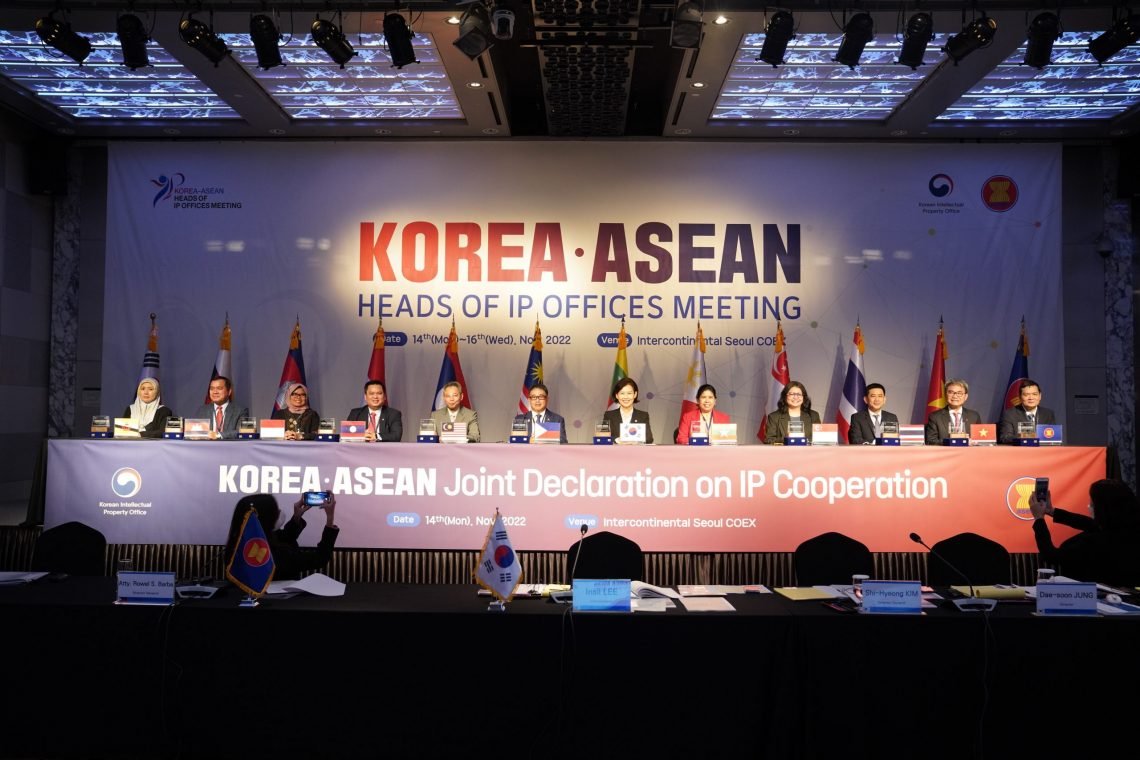
The 5th meeting of leaders of IP offices of ASEAN countries – Korea
From November 14 to 16, 2022, the delegation from the Intellectual Property Office (IP) of ASEAN member countries attended the 5th meetings of leaders of IP offices of ASEAN countries – Korea held in Seoul, South Korea. The delegates from ASEAN countries highly appreciate the close cooperation relationship between ASEAN and the Republic of Korea in many fields, especially in the field of Intellectual Property established since 2018. The Chairman of the Intellectual Property Cooperation Working Group – the Director of [...]

International Conference on Intellectual Property to be Hosted in 2022 in China, Japan, and Korea
The 2022 international symposium on intellectual property was jointly hosted on December 28, 2022, by the Chinese Intellectual Property Society (CIPS), the Intellectual Property Association of Japan (IPAJ), and the Korea Intellectual Property Society (KIPS). Heads of IPAJ and KIPS, CIPS President Tian Lipu, and Deputy Commissioner Lu Pengqi of the CNIPA delivered keynote speeches during the opening session. According to Lu, the international symposium has borne fruit 10 times over and is one of the main platforms for China, [...]
Amendments to the Patent Law in South Korea
For applications submitted on or after April 20, the updated Patent Act establishes a new mechanism under which, in the event that the final rejection is upheld, the applicant may remove the claims that have not yet been finally rejected from the application and file them independently. According to the prior version, even if one claim in an appeal against a final denial was dismissed, all other claims would also be collectively rejected. Extension of time to appeal a decision [...]

New Amendments to Korean Acts from April 2022
To adapt to the ongoing changes in Korean society, the Korean Government has introduced new Amendments to Korean Acts from April 2022. These amendments will likely improve the IP system in a way to facilitates the rights holders to protect their rights. Previous to the Covid-19 pandemic, when the non-extensible deadline lapses, it was hard for the rights holders to reinstate a proceeding or a right unless there was an excuse for “force majeure” to the extent of “war” or [...]
Required documents of trademark renewal in South Korea
Overview of renewal trademark in South Korea (Korea) The term of a registered trademark in Korea is ten years from the date of registration, renewable an unlimited number of times every ten years. A renewal application should be filed within 1 year before the expiration date. This term may be extended by a 6 month grace period after the renewal due date. There are some required documents that you need to prepare for trademark renewal as follows: Required documents The registration certificate (A [...]

South Korea issues more severe penal sentences for stealing or leaking technology secrets
South Korea has enacted stricter legislation to combat the theft and leaking of technical knowledge, reflecting its commitment to protecting industrial technology and national security. Under the updated Prevention of Divulgence and Protection of Industrial Technology Act, the guidelines for punishing information leaks became effective on March 26, 2024, with even harsher penalties for smuggling technology-related information set to commence on July 1, 2024. Increased Sentences and Fines: Intellectual Property Leaks Overseas: The maximum prison sentence for disclosing South Korean intellectual [...]

Cambodian and South Korean leaders address key intellectual property issues
On May 17, 2024, Cambodia’s Minister of Commerce and Chairperson of the National Committee for Intellectual Property, Cham Nimul, met with representatives from the Korean Intellectual Property Office (KIPO) to discuss ways to enhance cooperation in intellectual property (IP) training and exchange perspectives on significant IP issues. Minister Nimul highlighted the productive collaboration between KIPO and Cambodia’s Ministry of Commerce over the years, which has led to significant achievements. One notable outcome is the forthcoming signing of a Memorandum of [...]
Frequencly Asked Questions
The required documents for renewal a trademark in South Korea is Power of Attorney. The grace period is 06 months from the expire date of the trademark registration.
The trademark registration may be recorded online on customs data, but it is not automatically mechanism.
A trade mark shall be registered for a period of 10 years from the registration date
A trademark must be used in the commercial scale within three years after its registration, or within the three years immediately preceding the filing date of any non_-use cancellation action. However, there are no definition of “Commercial scale”.
The cancellation of trademark registration in South Korea is available. A trademark may be cancelled where:- The registered trademark conflict with the earlier trademark;
– The trademark consists the signs are undistinguishable such as the sign indicates the kind, quality, quantity, intended purpose or value of goods/services or other characteristics of goods or services.
– The marks that breach the copyright of another parties.
– The mark that are similar or identical with the well-known trademark;
– The mark that are similar or identical with the armorial bearings, flags and other state emblems;
– The mark that are conflict with the protected industrial design or geographical indication.
– The mark is generic;
– The mark is against the public policy or morality of the social.
– The mark that are deceive the public.
Any parties have the right to file opposition against an applied trademark before it has been granted the protection
Proof of use is not required for obtaining the protection of trademark. However, it is required to have Proof of use for defending the trademark against the non-use claim.
After getting trademark registration, the owner of trademark has the right to defence the trademark against the infringement action, unfair competition, unlawfully use of the trademark or have the right to license or transfer the trademark registration to another party.
